


A Birder Reviews Wingspan: Americas Expansion

Updated: Mar 16

You may be the sort of person who enjoys your outdoor adventures indoors. Consider, for instance, how few of us would engage in anything agricultural if it weren’t for Farmville, Stardew Valley, or Minecraft. Maybe the only fishing you’ve ever attempted was via Bassmaster Fishing on your PS5. And since the world’s been pretty well mapped and settled, we all have to settle for braving virtual dysentery on the pixelated Oregon Trail.
Our forefathers would be so proud.
But if you sometimes prefer birding from an easy chair, and you haven’t yet discovered the board game Wingspan, you really should. It’s the perfect board game accompaniment to your binoculars.
Wingspan is an engine-building game where various cards representing various birds are played across three habitats, laying eggs and gobbling food to score points and grow an aviary. The original base game, focused on North American birds, was released in 2019 by Stonemaier, who have a much-deserved reputation for making their games absolutely beautiful. The Wingspan artwork is gallery-worthy—and in fact spawned a live exhibit in Missouri, and eventually a book to showcase the paintings.
The game quickly surpassed all the expectations of its creator Elizabeth Hargrave and the folks at Stonemaier. Expansion modules soon followed, celebrating the birds of Europe (2019), Oceania (2020), and Asia (2022); together these four box sets have amassed almost 600 unique bird cards. But this month the newest expansion, Wingspan Americas, adds another 111 species from Central and South America. It’s equally gorgeous (utilizing two of the same three artists) and the early reviews (well, the reviews of my wife and me, at least) are very positive.

Wingspan gets high reviews across the board, and a quick Google search will unearth plenty of commentary on the gameplay itself. But I’m writing this review to specifically draw attention to all the nods and winks to actual real-life bird behavior. This is what I love most about Wingspan; it’s scientifically researched without requiring an advanced degree of its fans. Each card’s egg capacities, wingspans, nest types, food habits, and habitat preferences are all true to life. And in many cases the “power” of the card (the action it takes) is an ode to the bird itself.
Let me explain what that looks like in the original base set, and then I’ll explain how the new expansion has absolutely nailed it for the Americas.
Base Set Behaviors
Some of the allusions are obvious. The mimics—the Northern Mockingbird and Grey Catbird—imitate the powers of other birds. The Brown-headed Cowbird (that malevolent trickster) has no nest of its own, but lays eggs in the nests of other birds. The woodpeckers and nuthatches cache seeds. Bobwhites and quail keep cranking out eggs. The various birds of prey in the game get to go hunting—some for fish and rodents, others for other birds—with the circle-of-life chance for either failure or success. Many of the birds, such as the American Robin or Red-Winged Blackbird, have a “tucking” power that simulates flocking behavior, where one bird quickly amasses a following. And the power birds of the deck—the two ravens (Common and Chihuahuan)—are so powerful that in some permutations it’s recommended to remove them from gameplay. As perhaps the most intelligent birds on the planet, doesn’t it seem fitting to make them a bit super-powered? Likewise for threatened and endangered species: Hargrave gave each of these birds, like the Red-cockaded Woodpecker or the Atlantic Puffin, the special ability to collect bonus cards. Not every species has a behavior-related power, but enough of them do that it borders on genius.
Wingspan Americas Expansion
In the other expansions, each equally enjoyable, the behavior connections haven’t been as obvious to me, although I admit I’m not as familiar with the birds represented. But halfway into my first game with the Americas Expansion, I felt like I could almost see the birds flying around our dining room table. The experience is a credit to the game developers, and this might be the best bird simulator since the original.
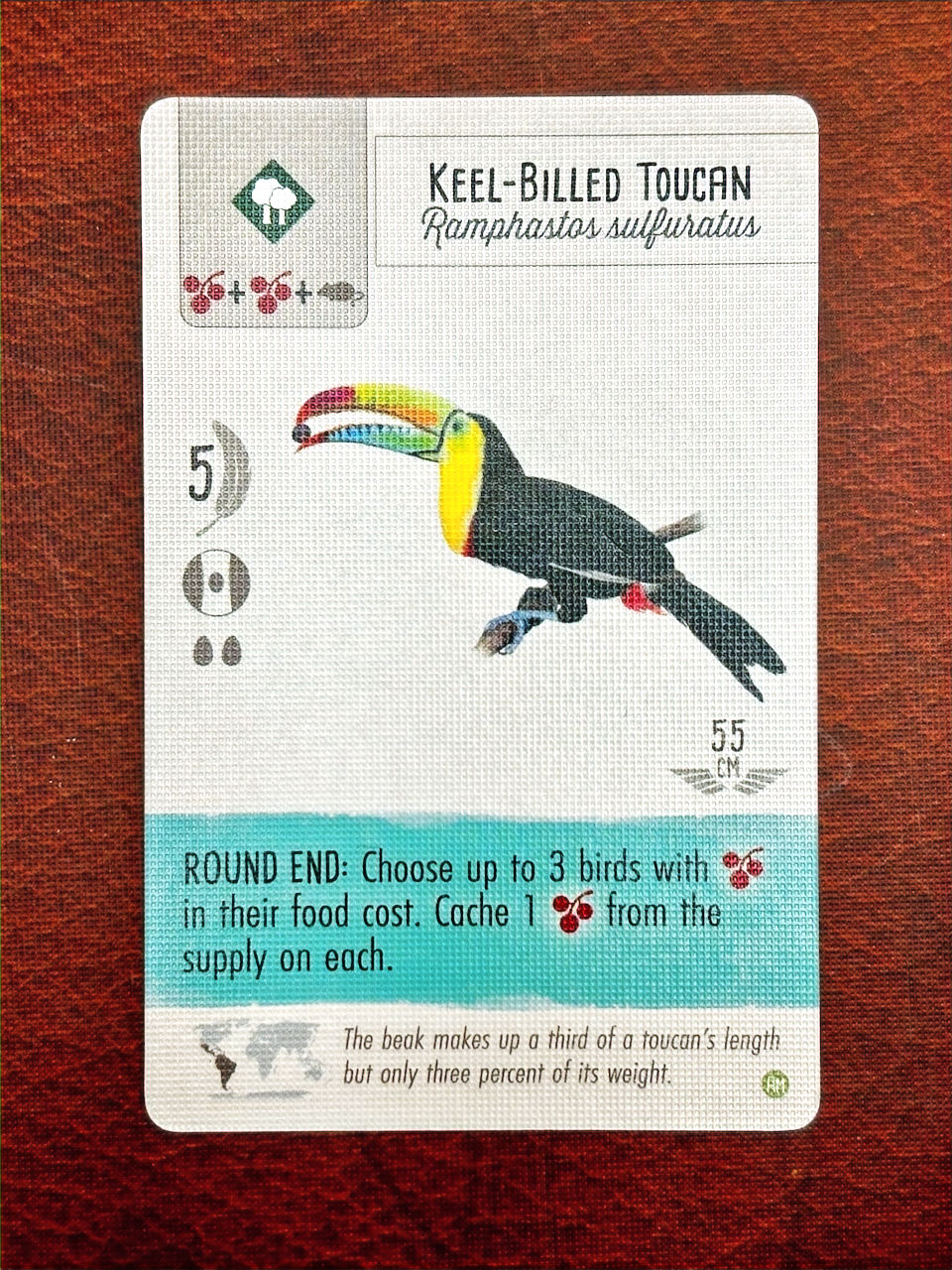
Let me explain a few of the wink-and-nod bird powers, and then describe the best part of the game. The Snowy Albatross—with the largest wingspan in the world—invites other big-winged birds along for the ride. The energetic Great Kiskadee and Tropical Kingbird (which have always struck me as unrelentingly active) flit between habitats and still keep moving. The Great-tailed Grackle can amass enormous flocks: an all-too-true experience if you’ve ever been under a raucous tree full of them. At the end of a round, the Keel-billed Toucan throws fruit around to other birds (an allusion to Froot Loops, perhaps?). The Boat-billed Heron’s enormous mouth grabs all the fish and invertebrates in sight. And the Neotropic Cormorant ensures there’s plenty of fish for everyone.

Those are some of the intentional fun facts thrown into the game. But the real magic comes when you lay the newly added "hummingbird garden" into the middle of the table. Hargrave explains the challenge of adding a region of the world where one in ten species is a hummingbird; she wanted to feature them uniquely in this expansion, but “figuring out how to include a significant number of them in Wingspan was tricky—they all have similar sizes, nests, and food.” What she created absolutely simulates my own hummingbird-watching experiences in places like Costa Rica and Panama. In those surreal moments, in a sunlit patch of flowering orchids or hibiscus, there’s so much frantic activity going on that a bird’s apt to disappear before you can even think about ID'ing it. They flit from flower to flower, and then they’re gone, maybe circling back in ten or fifteen minutes for another drink of nectar. It’s hyper-nonstop. In Panama I eventually just pulled out my camcorder (this was pre-iPhone days; don’t mock me…) so I could hopefully pull some stills from the footage for later identification. You do the best you can.
The forty hummingbirds Hargrave chose, all printed on smaller cards, don’t stay put for long. They’re constantly flitting between your board, the garden, and the boards of your fellow players. Sometimes they come and go on their own; other times they’re drawn in or spooked by the activity of other birds, like the arrival of a Crested Oropendola or the movements of the two macaws in the deck. And occasionally a bird causes such a stir that the hummingbirds of fellow players get stirred up too—such as the appearance of a Turquoise-browed Motmot or the creepy piercing yell of a Screaming Piha (never heard a Screaming Piha? By all means, stop reading this post and watch this…).
As they hum about, the hummingbirds bring gifts and leave with points, and if you can harness their movements effectively you can add up to fifty points to your final score (in Wingspan that’s a ridiculous amount of points, by the way).

What I loved about the original base game was the way you could feel the birds within it—hunting prey or imitating other birds or plopping random eggs around. This is part of the joy of the game for me, and the Americas expansion nailed it with hummingbirds.
Wingspan is wonderfully educational without being encumbered by it. Each card includes a bird fun fact. And the bird powers have actually found their way into my field birding. When I tell my wife I saw a Canvasback today, she’ll say, “Four points, star nest, everyone draws a card.” Or if there’s an American Goldfinch in the feeder, she recites, “Bowl nest, three egg capacity, gain three seeds.” She’s got a pretty impressive Mensa-capacity for Wingspan. If you want to take your learning next-level, the online Steam version actually adds the bird songs and calls when you play them, bringing another layer of accidental learning awesomeness. But that would be encouraging you back to that addictive screen where you do all your farming and fishing and Westward-Ho-ing, and that feels like a move in the wrong direction.**
Wingspan: Americas was an early release at the Stonemaier Store, and is now available broadly, including online stores like Amazon. Keep in mind that none of the expansions work without the base game, so if you’re new to Wingspan, start here.
** You can simulate the experience with an app called Wingsong that scans the cards on your phone and plays the songs—a truly great addition to your tabletop play.


fantastic!